History of the Atomic Bomb Dome
The Atomic Bomb Dome was built in 1915 as the Hiroshima Prefectural Commercial Exhibition Hall, designed by the Czech architect Jan Letzel. At 8:15 a.m. on 6 August 1945 an atomic bomb exploded about 160 m away. The building burned out but partly stood. The city chose to preserve it in 1966, and UNESCO listed it in 1996.
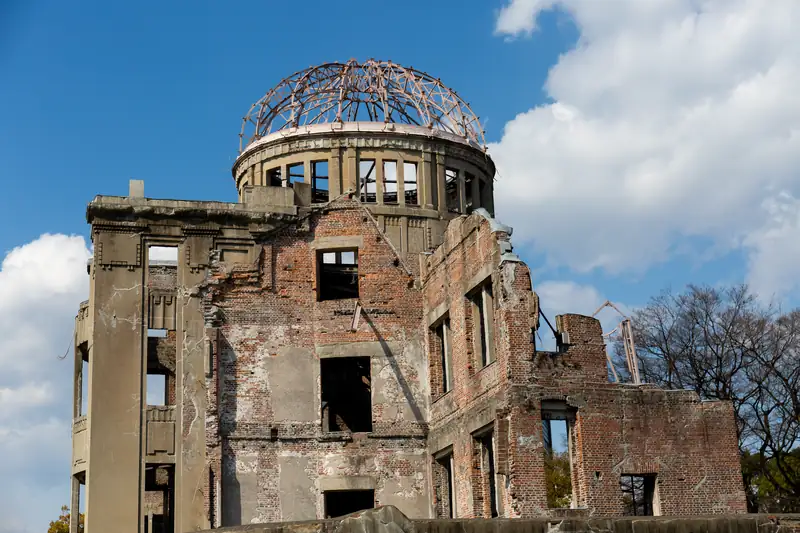
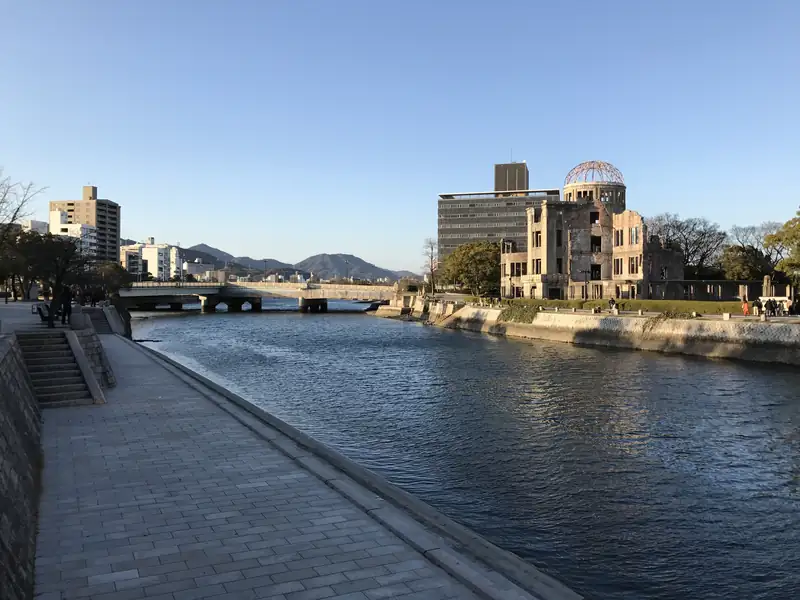
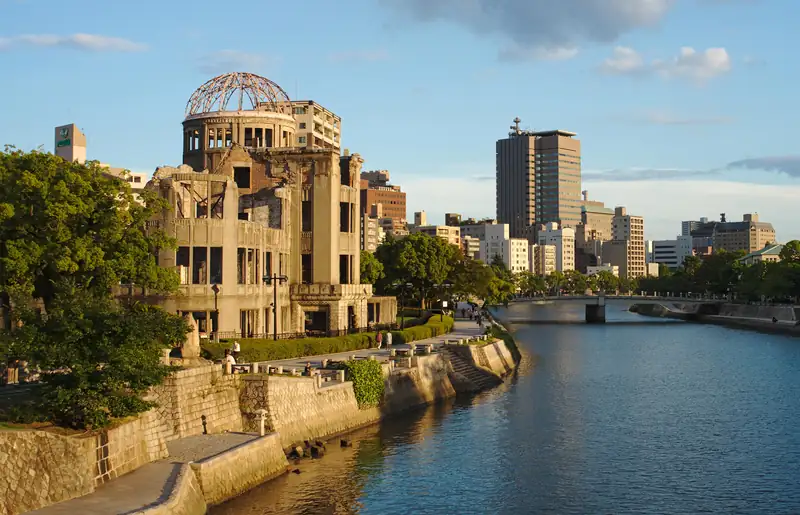
The Atomic Bomb Dome began as an exhibition hall. Hiroshima Prefecture commissioned it from the Czech architect Jan Letzel in 1910, and it was completed in April 1915 on the east bank of the Motoyasu River. For 30 years it was, in the city’s words, a familiar part of daily life. At 8:15 a.m. on 6 August 1945 an atomic bomb exploded about 600 m above the city, about 160 m from the building. The hall burned out, but its central part and dome frame stayed standing. Twenty-one years later the city decided to keep the ruin as it was, and in 1996 UNESCO added it to the World Heritage List.
The building, 1915 to 1945
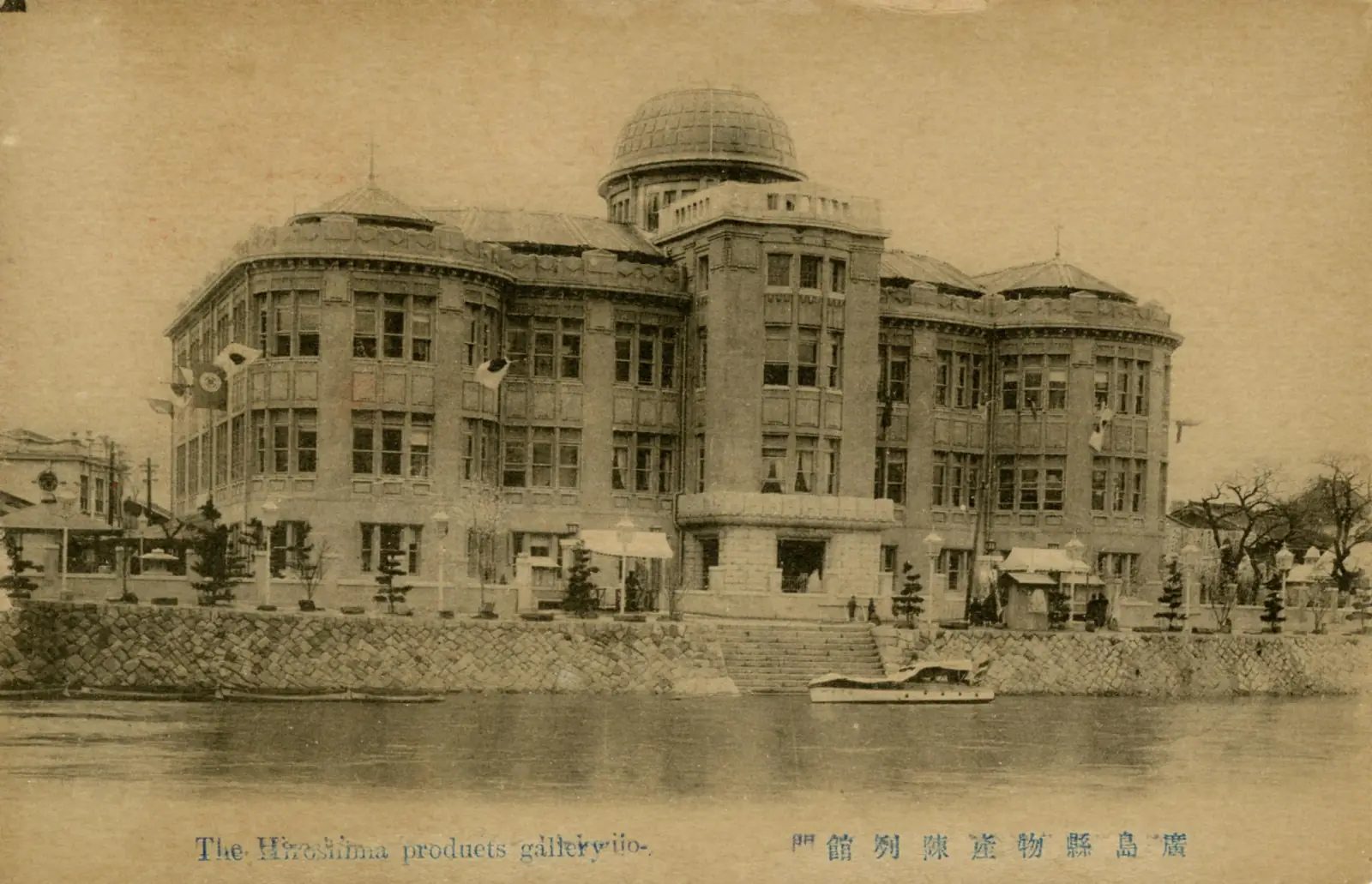
The Hiroshima Prefectural Commercial Exhibition Hall on a postcard from 1915 to 1921. Public domain, via Hiroshima City Archives.
Jan Letzel (1880 to 1925) drew up the design, and the contractor, Mukuda-gumi, started work in 1914. The design was three storeys of brick with partial steel framing, finished in stone and mortar, around a five-storey central stairwell. On top sat an oval copper dome about 11 m by 8 m and about 4 m high. The building stood 25 m tall, with a Western-style garden and fountain on its south side and a Japanese garden on the north.
Central Hiroshima was then mostly two-storey wooden buildings, so the hall was a novelty. Its reflection in the river made it a well-known sight.
It was built to collect and display products from Hiroshima and other prefectures, and it offered trade research, a reading room and design advice. It also held art exhibitions. The building changed name twice:
| Years | Name |
|---|---|
| 1915 to 1921 | Hiroshima Prefectural Commercial Exhibition Hall |
| 1921 to 1933 | Hiroshima Prefectural Products Exhibition Hall |
| 1933 onward | Hiroshima Prefectural Industrial Promotion Hall |
From 31 March 1944 its exhibition work ended. The building was turned over to government offices, among them the Interior Ministry’s Chugoku-Shikoku Public Works Office and the Hiroshima District Lumber Control Corporation.
6 August 1945
At 8:15 a.m. on 6 August 1945 the United States dropped an atomic bomb on Hiroshima. The bomb, a uranium weapon known as Little Boy, was carried by the B-29 bomber Enola Gay. It exploded about 600 m above Shima Hospital, in the city centre. The Industrial Promotion Hall stood about 160 m to the northwest of that point, the hypocentre. The Aioi Bridge guide covers the hospital site and the marker there today.
Everyone working in the building that morning died. We found no official count of how many people that was.
About 350,000 people were in Hiroshima that day, including soldiers, workers brought in from outside the city, people from Korea, Taiwan and mainland China (some of them conscripted), a few foreign students and American prisoners of war. The City of Hiroshima and the Peace Memorial Museum estimate that about 140,000 of them, give or take 10,000, had died by the end of December 1945. The Radiation Effects Research Foundation gives a range of 90,000 to 166,000 deaths in the first two to four months. The exact number will never be known: records were destroyed, whole families died together, and no one knows how many forced labourers were in the city.
Why the United States used the bomb, and whether it should have, has been argued by historians ever since. This guide takes no position on that question and keeps to what happened here.
Why part of the building stood
The city’s explanation is short. The blast struck from almost directly above, so the central part of the building withstood the impact while the rest was wrecked and burned out. The museum’s monument guide says the same: because the force came from nearly straight overhead, some walls escaped total collapse.
What remained was the steel frame of the dome, the walls around the central stairwell and parts of the outer walls. After the war, people in Hiroshima began calling the ruin Genbaku Dome, the Atomic Bomb Dome, because of the bare frame on top.
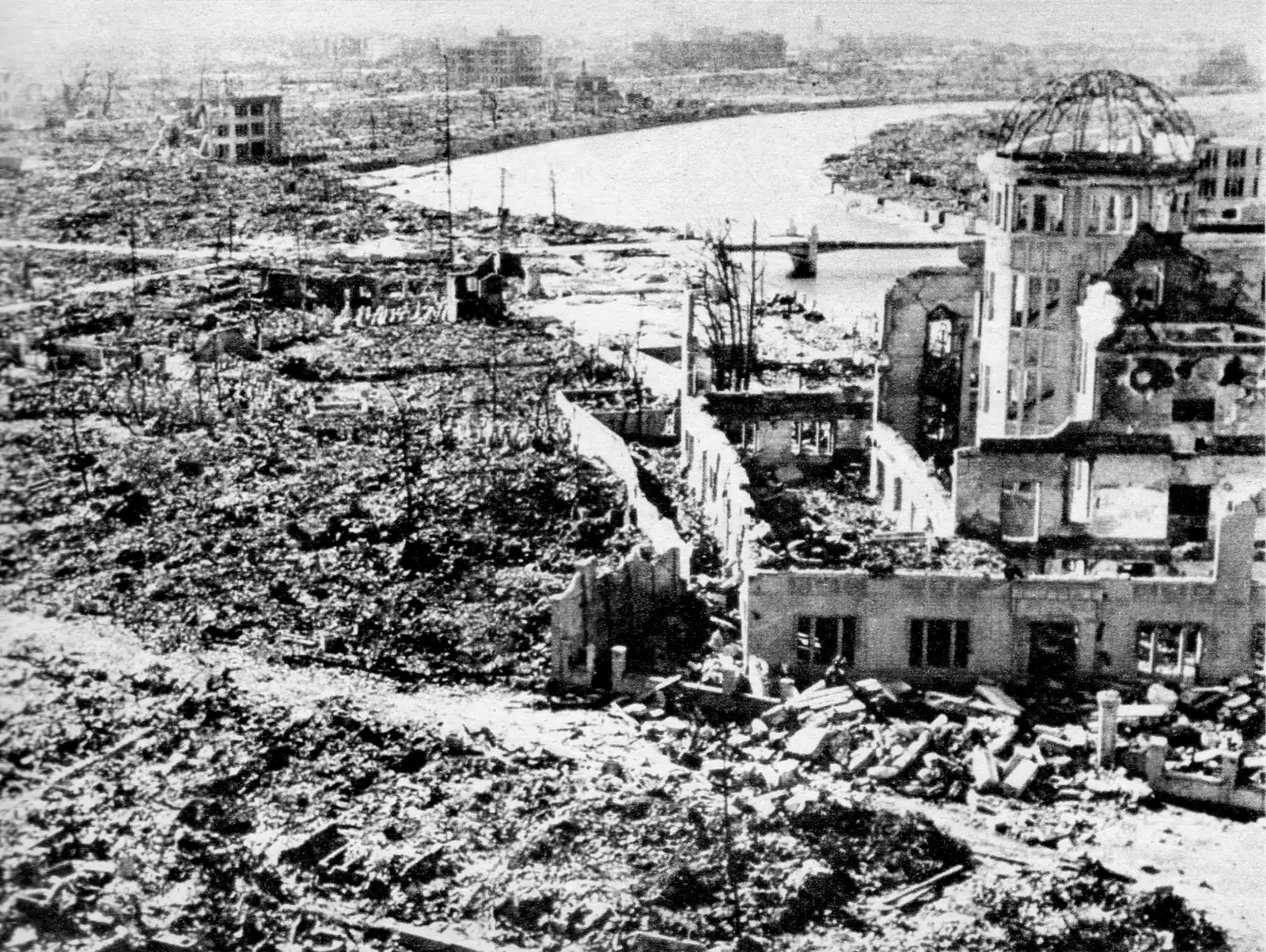
The area around the Dome in about 1945. Public domain.
It was one of very few buildings near the hypocentre that kept its shape. Another, the Rest House in what is now Peace Memorial Park, stood 170 m from the hypocentre.
Keep it or pull it down
After the war, opinion in Hiroshima split. Some people wanted the ruin kept as a memorial. Others wanted it demolished, both because it was dangerous and because it was painful to see every day.
The prefecture handed the building to the city in 1953. In 1962 the city fenced it off and banned entry, because bricks were falling. In July 1965 Hiroshima University’s architecture department began a survey of its strength.
On 11 July 1966 the Hiroshima City Council passed a resolution to preserve the Dome. A public fundraising campaign began on 11 November 1966 with a target of 40 million yen. It reached the target and closed on 14 March 1967. By 31 July 1967, donations had reached 66,197,816 yen from more than 1.3 million people in Japan and abroad.
Five preservation projects
The aim of every project has been to keep the Dome as it was left in 1945, not to restore it.
| Project | Dates | What was done | Cost |
|---|---|---|---|
| 1 | 10 Apr to 5 Aug 1967 | Cracks glued with resin, walls propped, internal steel bracing added | ¥51.5m, all from donations |
| 2 | 31 Oct 1989 to 31 Mar 1990 | Slowed decay of concrete, brick and earlier repairs; replaced corroded steel | ¥203.78m (¥100m from donations) |
| 3 | 8 Oct 2002 to 10 Mar 2003 | Metal caps over wall tops and sills against rain | ¥72.37m |
| 4 | 16 Nov 2015 to 29 Jul 2016 | Steel reinforcement on three walls against earthquakes | ¥32.96m |
| 5 | 29 Jun 2020 to 30 Apr 2021 | Steel repainted, brick joints, window mullions and fixings repaired | ¥79.33m |
Source: City of Hiroshima, checked October 2026.
A second fundraising campaign in 1989 raised over 395 million yen, and the surplus went into the Atomic Bomb Dome Preservation Fund that has paid for later work. Many older guides, and UNESCO’s own description, still say three projects; there have been five.
The city has surveyed the Dome’s condition roughly every three years since 1992. The tenth survey, in fiscal 2024, found age-related cracking but no notable deterioration. No works were under way in October 2026. In June 2026 the city’s expert committee reviewed a plan to make test samples copying the Dome’s brick, mortar and plaster and leave them outdoors from fiscal 2026 to 2039, to choose methods for a future repair. The city’s policy is to avoid visible changes and use methods that can be undone.
World Heritage, 1996
Japan joined the World Heritage Convention in September 1992. At first the national government objected to nominating the Dome: it was not protected under the cultural properties law, and it was seen as too recent. A citizens’ committee formed in June 1993 collected 1,653,996 signatures, and both houses of the Diet accepted the petition in 1994. The criteria for historic sites were revised in March 1995, the Dome became a national Historic Site that June, and Japan nominated it in September 1995.
The World Heritage Committee inscribed it on 5 December 1996, at its session in Mérida, Mexico, as the Hiroshima Peace Memorial (Genbaku Dome). It was listed on criterion (vi) alone, for its associations with events and ideas, which is unusual.
Two members recorded statements. China expressed reservations, saying that other Asian countries suffered the greatest losses in the war and that the listing could be misused by the few who deny this. The United States dissociated itself from the decision, citing a lack of historical perspective in the nomination and saying that war sites fall outside the scope of the Convention.
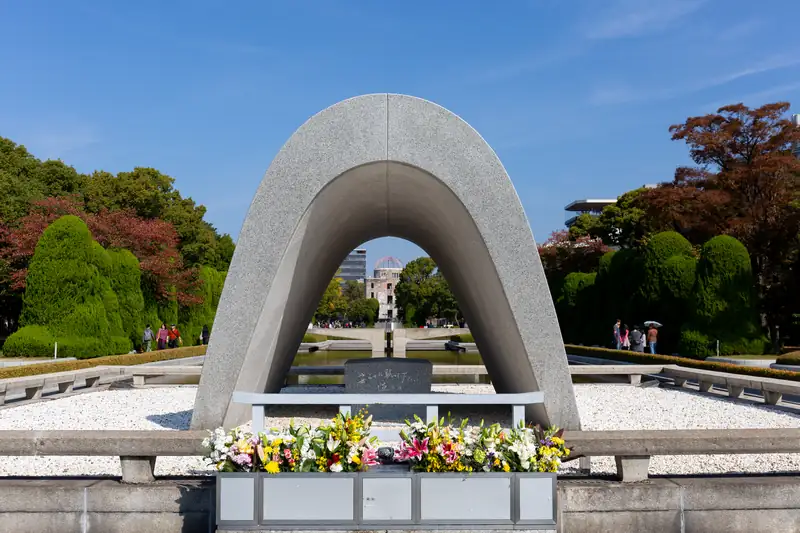
The protected property covers 0.40 hectares, with a 42.7-hectare buffer zone that includes Peace Memorial Park. Hiroshima City manages it.
Seeing it today
You cannot go inside. The Dome is viewed from the public paths around its fence, with no ticket, and it is lit at night. The homepage covers visiting, and Hiroshima today describes the city that was rebuilt around it.