Mitaki Temple (Mitaki-dera), Hiroshima
Mitaki Temple (Mitaki-dera) is a wooded hillside temple in north-west Hiroshima, named for its three waterfalls. Take the JR Kabe Line three stops from Hiroshima Station to Mitaki, then walk uphill for 15 to 20 minutes. It opens 8:00 to 17:30, closing at 17:00 in winter. Its pagoda came here in 1951 to remember the bombing's dead.
To reach Mitaki Temple, take the JR Kabe Line from Hiroshima Station to Mitaki, the third stop, then walk about 1.2 km uphill. The walk takes 15 to 20 minutes. Mitaki-dera is a wooded temple on a hillside in the north-west of the city, named for the three waterfalls in its grounds. It is open from 8:00 to 17:30, and closes at 17:00 in winter.
It is a short trip from the centre and a change from the crowds at the Peace Memorial Park, though it has its own link to 6 August 1945.
Getting there by JR Kabe Line
| Step | Details |
|---|---|
| Train | JR Kabe Line from Hiroshima Station. Mitaki is the third stop, after Shin-Hakushima and Yokogawa; about 10 minutes |
| Station | Mitaki Station is small and unstaffed, with a ticket machine and one island platform |
| Walk | About 1.2 km, uphill, 15 to 20 minutes. Our route estimate uses OpenStreetMap |
| Return | Same way. Check the time of the next train before you leave the temple |
The fare is a short local JR fare; we could not confirm the exact amount from JR in October 2026, so check the ticket machine or use an IC card. Kabe Line trains leave from Hiroshima Station’s JR platforms, not from the tram stop.
What you see at Mitaki Temple
Mitaki means “three waterfalls”. The falls are fed by four mountain streams that run beside the main path, and in places across it. Trees muffle the sound of the city, and the moss-covered rocks and statues make it a restful place.
The temple holds hundreds of stone Buddha statues, some dating from the Kamakura period (1185 to 1333), spread among ten wooden buildings. Eighty-eight of the statues are dedicated to the temples of the Shikoku pilgrimage and are laid out so you can make a small pilgrimage of your own from the entrance. The main hall is dedicated to Kannon, the bodhisattva of compassion.
The temple was officially founded in the ninth century, and traces its history back to the Nara period (710 to 794). Most of the buildings date from the 19th and 20th centuries. At the top of the winding path is an old stone altar carved into the rock face, with a tall sacred tree in front of it and a Meiji-era shrine beside it. From there, a 10-minute walk further up the mountain reaches a bamboo forest.
Look out for the shrine to three oni, ogre-like figures from Japanese folk tales, with carved faces above its entrance. An old stone path beside it climbs for about three minutes to a lookout over Hiroshima.
The temple’s tea room sits beside a waterfall. It opens to the public for one week a year, usually in the third week of November. All of the details in this section come from Japan’s Tourism Agency, which wrote them with the City of Hiroshima.
Mitaki Temple and 6 August 1945
The temple is about 3.2 km from the hypocentre of the atomic bombing. Its wooden buildings were badly damaged on 6 August 1945. The roof of the main hall collapsed, but the building did not catch fire, so the statues and sacred objects inside survived. The main hall was rebuilt in full in 1968.
The oni shrine near the main hall still shows the damage. Its wooden roof pillars buckled but did not break.
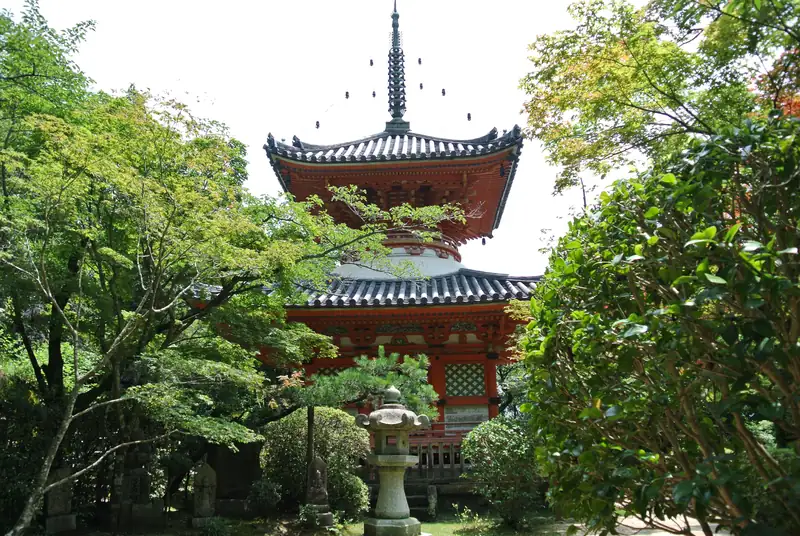
Since the war the temple has taken an active part in remembering the dead and in work for peace. The vermilion two-storey pagoda (tahoto) at the entrance was brought from a shrine in Wakayama Prefecture in 1951, as part of a memorial service for those who died in the bombing. Water from the temple’s four streams has been offered at the annual remembrance ceremony in the Peace Park, held on Hiroshima Day.
Small shrines and monuments in the grounds remember the victims of other tragedies and wars. One is a stone memorial, with a dedication in English and Japanese, to those who died at Auschwitz.
Treat the grounds as you would the Flame of Peace or the Cenotaph: speak quietly and keep to the paths.
When to go
Autumn, when the leaves turn as red as the pagoda, and spring, when cherry trees bloom nearby, are the most popular seasons. The paths are steep and can be wet near the waterfalls, so wear shoes with grip.
No tour in our list goes to Mitaki Temple, and you do not need one. For more places to fit around the Peace Park, see things to do in Hiroshima or our Hiroshima itinerary.