Shukkeien Garden: fees, hours and its history
Shukkeien is a walking garden built in 1620 for the Asano lords, about 1.3 km from the Atomic Bomb Dome. Entry is 350 yen for adults and free for high school students and under. It opens at 9:00 and closes at 17:00 or 18:00 by season. The 1945 bombing destroyed every building except the stone bridge.
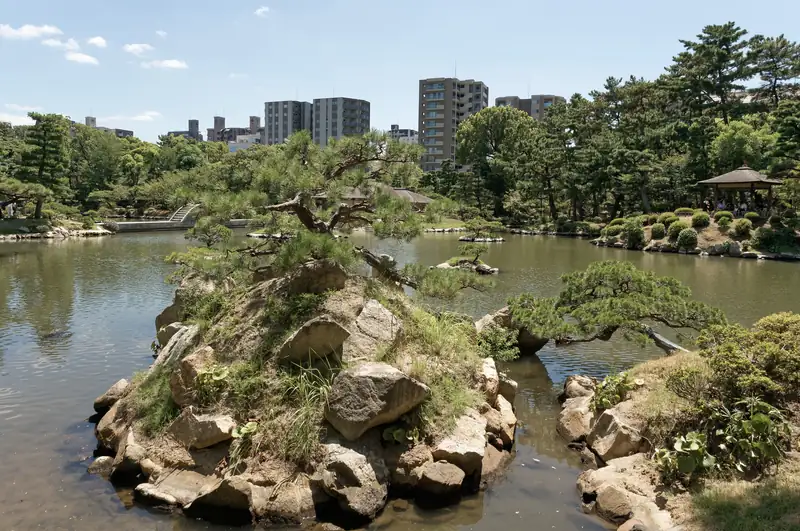
Shukkeien Garden costs 350 yen for adults and is free for high school students and younger. It opens at 9:00 and closes at 18:00 from mid-March to mid-September and at 17:00 the rest of the year. The garden was laid out in 1620 for the Asano lords of Hiroshima and stands about 1.3 km from the Atomic Bomb Dome. The bombing on 6 August 1945 destroyed every building in it except the stone bridge.
Fees and hours
Checked October 2026, from Shukkeien’s official guide page:
| Ticket | Price |
|---|---|
| Adult | 350 yen (groups of 20 or more: 250 yen) |
| University student | 150 yen (group: 100 yen) |
| High school student and younger | Free |
| Aged 65 and over (with proof of age) | Free |
| Combined with the Hiroshima Prefectural Art Museum | 660 yen adult, 350 yen university |
| Season | Hours | Last entry |
|---|---|---|
| 16 March to 15 September | 9:00 to 18:00 | 17:30 |
| 16 September to 15 March | 9:00 to 17:00 | 16:30 |
The garden closes from 29 to 31 December. Entry is free for everyone on Greenery Day (4 May) and Culture Day (3 November). Older guides quote 260 yen; that price is out of date.
What the garden is
Shukkeien means roughly “shrunken scenery garden”. It is a stroll garden: you follow a path around a central pond, Takuei Pond, and the views change as you go. The pond holds 14 islands, seven on each side of an arched stone bridge, and tea houses, small bridges and arbours sit around its shore.
Ueda Soko, a senior retainer of the Asano family and a tea master, built it in 1620 as a villa garden for Asano Nagaakira, the first lord of the Hiroshima domain. It was first called “Sensui” or “Sentei”. The present name came later, from a poem the second lord asked for. A fire in 1758 destroyed many of its buildings, and a long rebuilding began in 1783. In 1940 the Asano family gave the garden to Hiroshima Prefecture, and it was designated a National Scenic Beauty the same year.
Shukkeien in 1945
The atomic bombing of Hiroshima on 6 August 1945 left the garden in ruins. Japan’s Tourism Agency records that every structure was destroyed except the stone bridge. Many injured people fled into the garden and died there, according to the Hiroshima Culture site.
Photographs taken afterwards showed that bodies had been buried in makeshift graves in the garden. A memorial to the victims of the bombing now stands near the river on the garden’s eastern side.
Restoration began in 1949 and took until 1974. The tea houses and pavilions you see today were rebuilt after the war.
The A-bombed trees
Three trees in Shukkeien are on the City of Hiroshima’s register of A-bombed trees, all 1,370 m from the hypocentre:
| Tree | Notes |
|---|---|
| Ginkgo | Named in the Tourism Agency’s description of the garden |
| Japanese black pine | Near the river on the east side; the Tourism Agency calls it the tallest of the surviving trees |
| Muku tree | Also on the city’s register |
They survived the bombing and the fires that followed. If you have seen the A-bombed trees in the Peace Memorial Park, these are part of the same story.
How long to stay
Allow 45 minutes to an hour to walk once around the pond at an easy pace. The garden suits a quiet hour after the Peace Memorial Museum. Hiroshima Castle is about 800 m to the north-west, so you can join the castle grounds, Shukkeien and the Peace Park in one half-day.
The bike tour picked above rides to the Peace Park and the Dome first and then on to the castle grounds and Shukkeien, with garden entry included.
Getting there
Checked October 2026, from Shukkeien’s access page:
| From | How |
|---|---|
| Hiroshima Station | Tram 1, 2 or 6, change at Hatchobori to the Hakushima line, get off at Shukkeien-mae; the entrance is by the stop |
| Hiroshima Station (Shinkansen exit) | Bus to Kenritsu Bijutsukan-mae (Shukkeien-mae) |
| Atomic Bomb Dome | About 1.3 km in a straight line; walk or take the tram via Hatchobori |
| By car | Garden car park: 400 yen first hour, 200 yen per 30 minutes after |
For more ideas nearby, see things to do in Hiroshima or the Hiroshima itinerary.