Hiroshima Peace Memorial Park
Hiroshima Peace Memorial Park is a free public park of about 12 hectares in central Hiroshima, built on the district destroyed on 6 August 1945. Its memorials line a north-south walk from the Peace Memorial Museum to the Atomic Bomb Dome, about 720 m, which takes 10 minutes without stops and an hour or more with them.
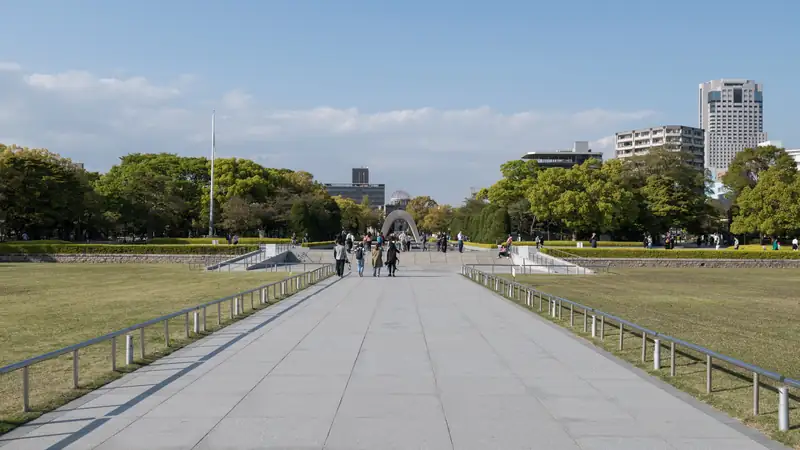
Hiroshima Peace Memorial Park is free and open to everyone, with no gate and no ticket. It covers about 122,100 m² on the west bank of the Motoyasu River, and its memorials sit along a straight walk from the Peace Memorial Museum in the south to the Atomic Bomb Dome across the river in the north. That walk is about 720 m. Many visitors see the museum first and then walk north through the park, and this guide follows that order.
What the park is, and what was here before
Before 6 August 1945 this was Nakajima, a busy commercial district of seven neighbourhoods with an estimated 6,500 residents. It lay close to the hypocentre of the atomic bombing of Hiroshima and was destroyed.
The Hiroshima Peace Memorial City Construction Law of 6 August 1949 gave the city the legal basis to rebuild as a city of peace. A design competition followed, and a team led by Kenzo Tange, then an assistant professor at the University of Tokyo, won first prize from 145 entries. The park was completed on 1 April 1954, according to the museum’s monument guide.
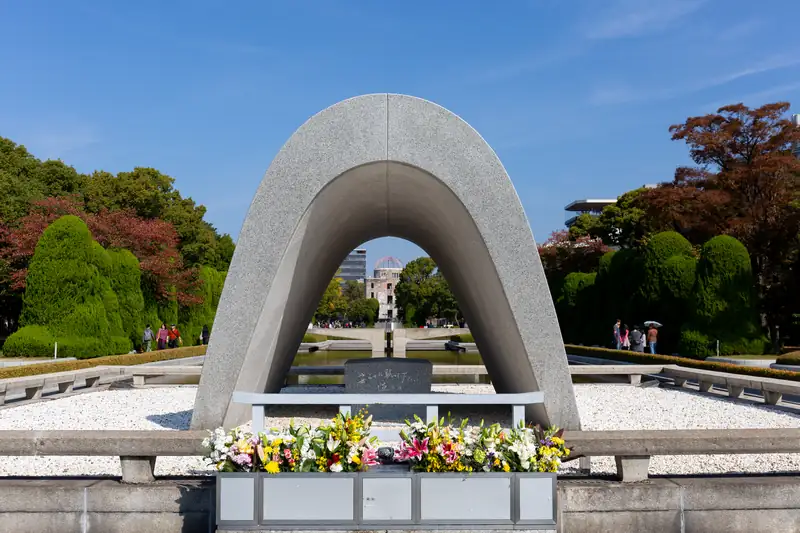
Tange placed the museum, the Cenotaph and the Dome on one north-south line. Stand at the museum and you see the Dome framed in the arch of the Cenotaph. The national government listed the central axis as a Place of Scenic Beauty in 2007 and the whole park in 2008.
The monuments in walking order
Start at the museum and walk north. The park has many more monuments than these; this list covers the ones most visitors look for.
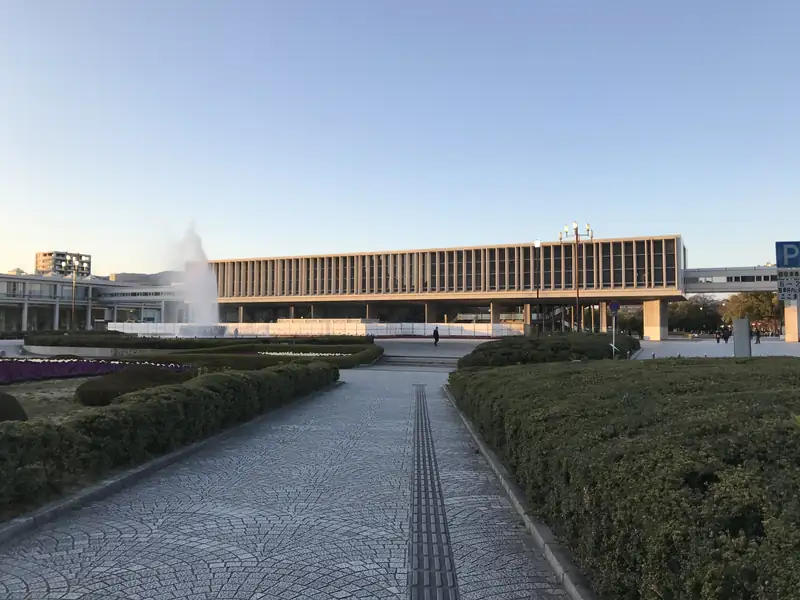
- The Peace Memorial Museum. Tange’s main building stands on pillars at the south end. The museum guide covers how long to allow and what is inside, and museum tickets has fees and opening hours.
- The A-bombed Phoenix trees. Two Chinese parasol trees stood 1.3 km from the hypocentre in the courtyard of the Hiroshima Post and Telecommunications Bureau. They were burned and stripped, then budded the next spring. They were moved to the park in May 1973, near the museum, and their seeds have been sent around the world.
- The Cenotaph for the A-bomb Victims. An arch shaped like an ancient clay house model, dedicated on 6 August 1952, over a stone chest that holds the register of names of those who died of the bombing. See the Flame of Peace and Cenotaph guide for the inscription and its meaning.
- The Flame of Peace. Lit on 1 August 1964 in the Pond of Peace, just north of the Cenotaph, and meant to burn until nuclear weapons are gone from the earth.
- Hiroshima National Peace Memorial Hall for the Atomic Bomb Victims. Opened by the national government in 2002, east of the Cenotaph and mostly underground. Its Hall of Remembrance shows a 360-degree view of the destroyed city made of 140,000 tiles, the estimated number of deaths by the end of 1945. Entry is widely reported as free; we could not confirm its hours on the hall’s own site.
- The Rest House. Built in 1929 as the Taishoya kimono shop and 170 m from the hypocentre, it kept its shell when its roof was crushed and the inside burned. Of 37 people working there that morning, one man who had gone down to the basement survived. The basement is preserved, and the building has been the park’s Rest House since 1982. We could not confirm current arrangements for seeing the basement.
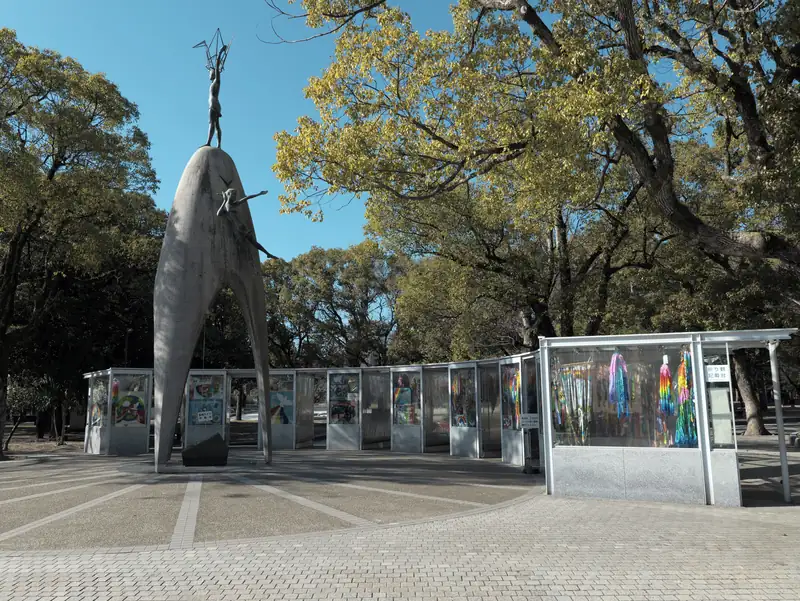
- The Children’s Peace Monument. A 9 m bronze from 1958, topped by a girl holding up a crane, with booths of paper cranes around it. Read the Children’s Peace Monument guide and the story of Sadako Sasaki.
- The Monument in Memory of the Korean Victims. First erected in 1970 at the west end of Honkawa Bridge and moved into the park in July 1999. It stands on a turtle-shaped base, west of the Children’s Peace Monument.
- The Atomic Bomb Memorial Mound. A grassy mound 16 m across, completed in 1955. The vault inside holds the ashes of roughly 70,000 people who were never identified or had no surviving family. An interfaith service has been held here every 6 August since 1946.
- The Peace Bell. Completed in 1964 and cast by Masahiko Katori, it carries a world map without borders. Visitor guides say anyone may strike it; we could not find that on an official page. It is not the bell rung at the 6 August ceremony, which is kept elsewhere.
- The Peace Clock Tower. Three twisted steel pillars, 20 m tall, holding a globe clock, near the Dome end of the park. It chimes at 8:15 every morning.
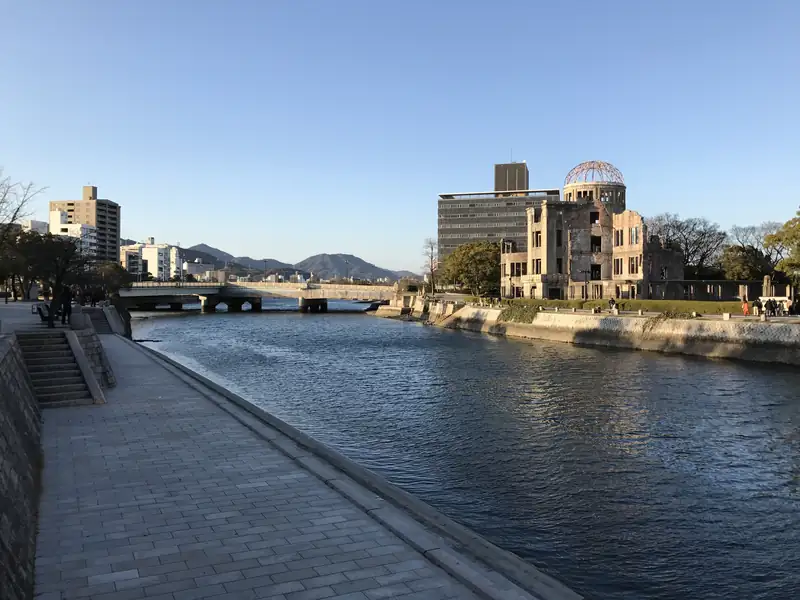
- Aioi Bridge, the Dome and the hypocentre. Cross to the east bank for the Atomic Bomb Dome, the T-shaped Aioi Bridge and the hypocentre marker, about 160 m from the Dome.
Free English tours by Hiroshima Peace Volunteers
The museum’s volunteer guides walk visitors round the park’s monuments, including the Dome, for free. You cannot book; you turn up and check in. Tours inside the museum are suspended.
Volunteer park tours (checked October 2026)
| Item | Detail |
|---|---|
| Fixed tours | 10:45 to 12:15 and 14:00 to 15:30 |
| Language | English |
| Price | Free |
| Group size | Up to 10 people |
| Meeting point | Peace Volunteers’ desk by the Information Desk, East Building 1F of the museum |
| Check-in | Opens 15 minutes before; first come, first served |
| Extra tours | On the spot if guides are free, 10:30 to 14:30 |
| No fixed tours | July, August and September; heat-stroke alert days; 1 to 3 January; 6 August; 29 December |
If you want a guide in the summer months, or a set time, a paid walk is the alternative. The tours page and best Hiroshima tours compare them.
Planning your visit
The park has no opening hours or fee. The museum does, and it sets the shape of most visits: it opens at 7:30, the early and late hours need an online reservation, and the city says it is most crowded from 11:00 to 15:00. A morning plan that works: museum at opening, then the walk north through the park, finishing at the Dome around midday.
Distances (checked October 2026)
| From the Dome to | Distance | On foot |
|---|---|---|
| Hypocentre marker | About 160 m | 2 minutes |
| Children’s Peace Monument | About 175 m in a straight line | 3 minutes |
| Peace Memorial Museum (East Building) | About 720 m | About 10 minutes |
| Genbaku Dome-mae tram stop | Next to the Dome | 1 minute |
| Hiroshima Station | About 2.6 km | About 35 minutes |
The tram from Hiroshima Station takes 15 to 20 minutes; how to get to the Atomic Bomb Dome has routes and fares. There is no public parking in the park.
Etiquette
The park is a city park where people jog and children play, and it is also a place of mourning. Both are true at once. A few things the official rules and plain courtesy ask:
- No smoking anywhere in the park.
- No drones. The city has banned them in the park since 2015.
- Speak quietly at the Cenotaph and the Memorial Mound. People come to pray there, and some lay flowers.
- Paper cranes go in the booths at the Children’s Peace Monument, tied in strings. The monument guide explains how.
- Photographs of the monuments are fine. Ask before photographing people who are praying.
When to go
Late October to November and March to May are the most comfortable months. August is the hottest, and the volunteer tours stop from July to September. On 6 August the park hosts the Peace Memorial Ceremony, and entry is restricted early that morning. Spring cherry blossom and the autumn school-trip season bring the biggest crowds, so arrive early or come back in the evening, when the Dome is lit.
For a full day that adds Hiroshima Castle or Miyajima, see the Hiroshima itinerary.